Church Branding 101: 5 Lessons From Brand Designer Benj Lyon

Church Branding 101: 5 Lessons From Brand Designer Benj Lyon
I sat down recently with Benj Lyon, founder of Holy Goat and a local church pastor himself, to talk about something that's been bugging me for a while:
Why do so many churches end up looking exactly the same?
Clearly, no one's being lazy. Most churches I've come across genuinely love their people and want to communicate well. But somewhere along the way, a lot of us ended up with the same fonts, the same stock photography, the same "join us Sunday" energy as the church down the road. Carbon copies.
And a lot of what fixes this, it turns out, is a lesson directly from the branding world, applied to something a lot more important.
"We look at churches and how churches seem to be branded, and a lot of them feel very similar. Carbon copies." Benj Lyon
Here are five lessons from our conversation that I think all leaders should reflect on:
Lesson 1: Ask the one question every great business asks
When a business goes through a branding process, one of the first things they do is what Benj calls a competitor analysis. For a business, this is not about attacking anyone else. It's about asking 'how are we different from everybody else?'. What's already being done well, and what makes us distinct?
Most churches skip this entirely. Understandably. We're not here to compete with the church down the road, and that's a good instinct. But somewhere along the way, "we're not competing" quietly became "so don't need to do anything differently." Those are two different things, and mixing them up is exactly how a church ends up losing their unique vision.
You don't need to compete with anyone to still be worth noticing. Knowing what makes you different isn't about winning. It's about being findable by the people God's already put in your path.
Lesson 2: Find what you're uniquely called to
Here's a tension Benj named. Every local church shares the same calling. Reach people, love God, worship him. That part's identical everywhere.
But the people in front of you aren't identical anywhere else. Neither is the city or village around you. Neither is the story God's given your specific leadership. Most churches understand the first half of that sentence really well. Very few have done the work on the second half.
The gap between "we know what we're called to" and "we're not sure what makes us specifically us" is where most churches get stuck, and it's exactly the gap a good brand process closes.
Lesson 3: Specify your target audience
This was the most practical part of our conversation.
In commercial branding, you build what's called an audience persona. Made up (or better, semi-real) people who represent who you're actually trying to reach. Give them a name, an age, a job, somewhere they live. Then talk about them constantly when you're making decisions.
This sounds like we're excluding people, but it's not. It's about trying to reach them. Naming who you're trying to reach doesn't shrink your desire to reach anyone outside this category, but it stops you trying to speak to everyone at once (which in practice, means speaking clearly to no one.)
I told Benj about doing this by accident when we planted our church in Kuala Lumpur.
In the early years, we kept noticing the same kind of person walk through the door. We called them the three Bs: bored, backslidden, and baggage. Almost everyone who came fit that description. Once we saw it clearly, everything got easier. We could design services for them. Preach toward them. Build small groups around them.
"The quicker you realize that your church is likely not for everyone, the more liberating it becomes." - Joel Burden
Lesson 4: Ask your church who they think you are
Benj's own church, Living Rock in Leicester, United Kingdom, is a great example of this. Their tagline, "an authentic church for the towns and villages," didn't come out of a leadership brainstorm. It came from a Sunday where the whole congregation saw about a hundred words on a screen and picked the three that felt most like their church. Not what leadership wanted them to feel. What they actually felt.
Words like authenticity and family came out on top. From there, everything followed. An earthy, organic colour palette. A visual pattern that echoes a dry stone wall, the kind you'd see out in the English countryside. Even the way they talk to people.
Your brand isn't something you invent from a whiteboard. It's something you notice, already sitting inside the people God's gathered around you, and then build outward from there.
"You are a unique, one-of-a-kind church reaching your community." -Joel Burden
Lesson 5: You are what people say when you're not in the room
Brand is what people say about you when you're not around.
Not what you'd like them to think. What they actually think, right now, whether you've ever tried to shape it or not. If you've never asked what people actually say about your church when no one from your team is in earshot, that's the honest starting point. Not a logo. Not a colour palette. That question.
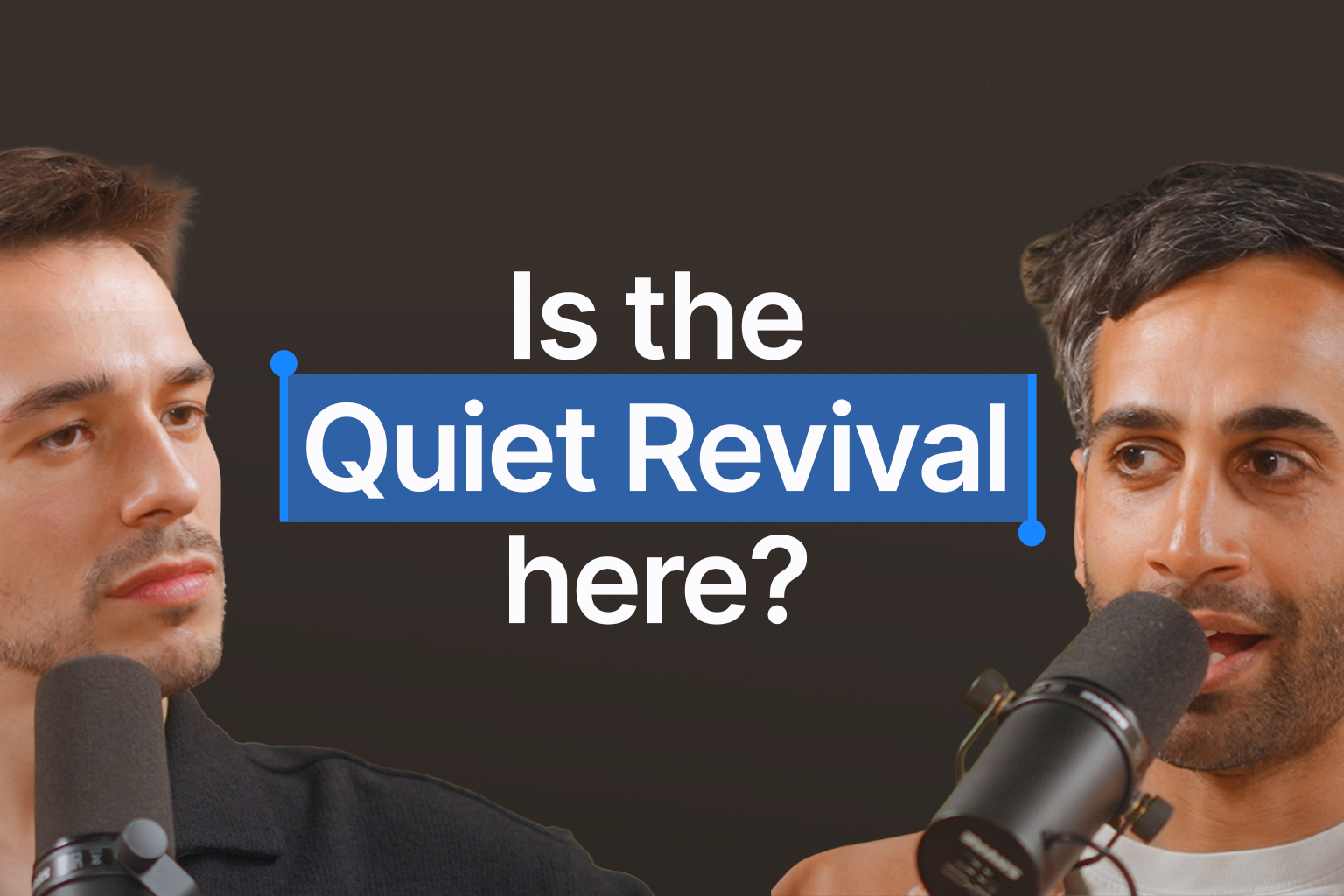
Let's listen to the full conversation here:
Want Help Building This Into Your Church?
If your team need assistance in branding your church, that's exactly what CloudCut Launch is built for.
What Is CloudCut Launch?
CloudCut Launch is our 12-week brand process for churches. We start with Strategy, uncovering who you really are through discovery and honest conversation. Then Expression, turning that into something visible: a distinctive logo, a clear identity your team can actually use. Then Content, putting it into the hands of your local team with kit and templates that get used week to week, not filed away and forgotten.
Frequently Asked Questions
What is CloudCut Launch?
CloudCut Launch is CloudCut's full church rebrand process. It takes your church through three stages: Strategy (discovery and messaging), Expression (concepts, logo, identity), and Content (kit and templates), so you come out the other side with a brand that's genuinely yours, not borrowed from another church.
How long does the process take?
The full 8-milestone Launch process is a guided journey through discovery, concepts, definition, application, identity, kit, and templates. Timelines vary by church, and we'll walk you through exactly what to expect on a Discovery Call.
Do we need to already know what makes our church unique before starting?
No. That's exactly what the Strategy stage is for. Most churches that come to us haven't yet put language around what makes them distinct. Uncovering that is the first part of the process, not a prerequisite for starting it.
What's the difference between CloudCut Launch and CloudCut Studio?
Launch is the one-time process that builds your brand from the ground up. Studio is our ongoing monthly retainer that keeps your content and communications running week to week once your brand is built. Using a flying metaphor: Launch builds the plane. Studio keeps it flying.
Do you only work with certain types of churches?
CloudCut works exclusively with churches. We're led by an active lead pastor, not a generic design agency, so we understand the pastoral side of this decision, not just the visual one.
More Articles
Read more articles from the journal


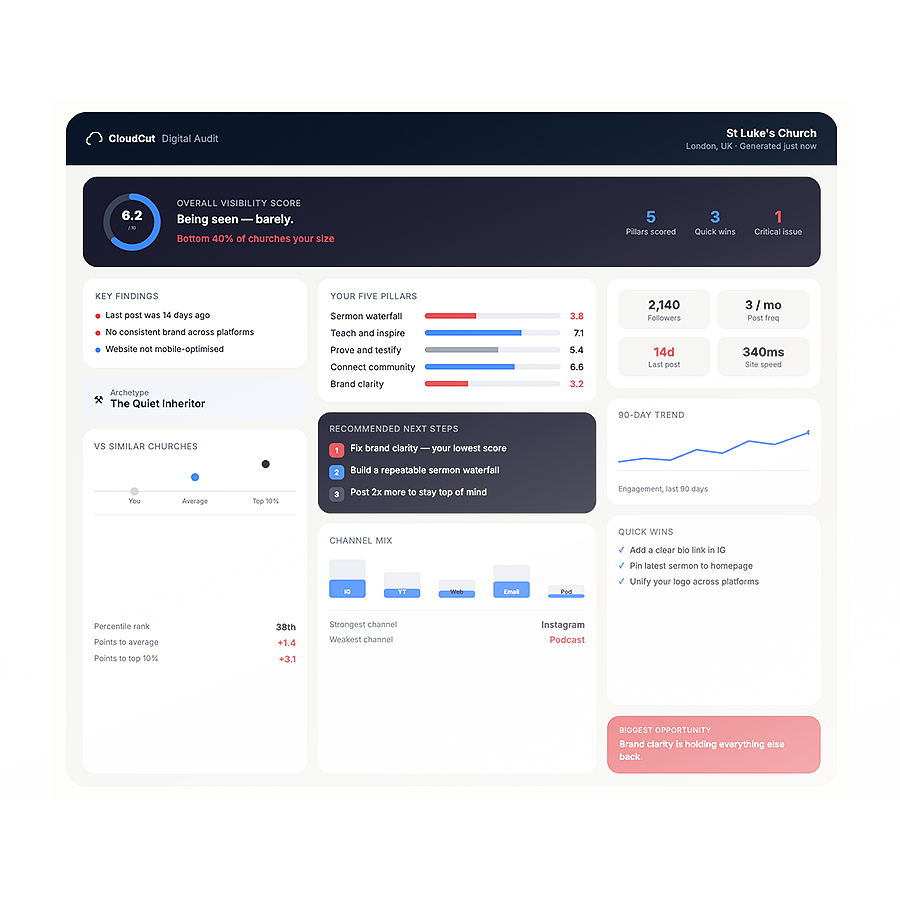
Free Church Communications Audit: See How Your Church Scores
In under 2 minutes, get an AI-powered report on how your church currently ranks online, what's holding you back, and some practical next steps.
Get clarity today. Book a call.
A 30-minute Clarity Call with Joel and the team. We'll talk through where your church is at and whether we could help.